
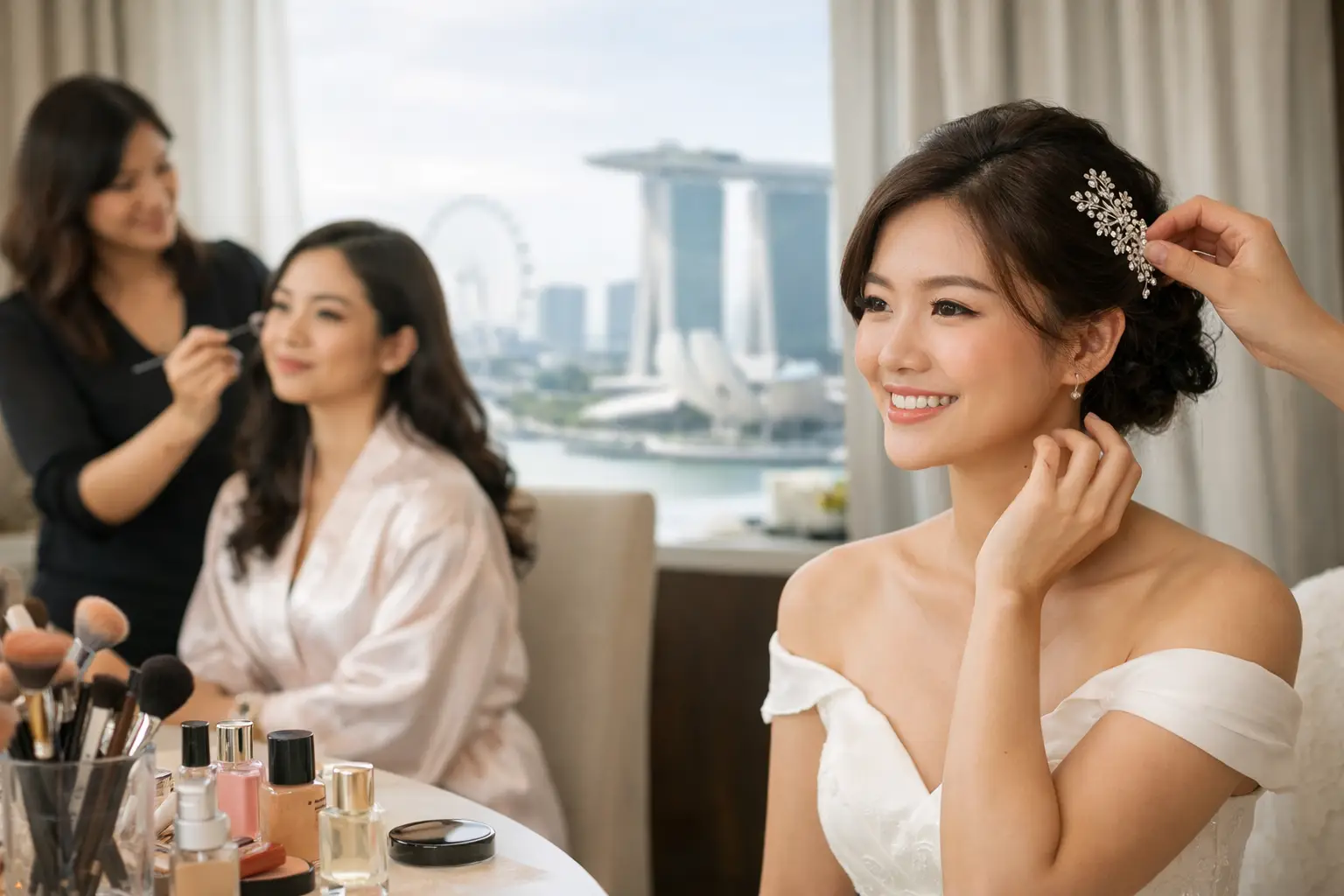
A guide to wedding beauty budgeting starts with protecting the moments that are hardest to repeat: your trial, your actual-day artist, and enough time for calm, camera-ready preparation. Set aside a realistic beauty allowance early, then tailor it around your number of looks, wedding schedule, skin needs and the people you would genuinely like to include.
Wedding beauty is not simply a line item for “make-up”. It is the quiet work behind skin that still looks like skin in close-up photographs, hair that holds through Singapore humidity, and a look that feels recognisably like you from your solemnisation to the final ballroom photographs. The right budget gives you choices. The wrong one often creates rushed decisions, unnecessary add-ons and a face that feels too heavy by lunchtime.
What should you include in a wedding beauty budget?
Start by separating your own bridal service from beauty for your wedding party. Your personal budget should account for the bridal trial, actual-day hair and make-up, any additional looks, early-morning timing, and touch-up or stay-on services if your schedule calls for them. Then consider mothers, sisters, bridesmaids and anyone who will be photographed prominently or whose getting-ready experience you want to make special.
For a Singapore wedding, it also helps to budget according to the format of your day. An ROM ceremony may need one fresh, polished look that reads beautifully in daylight and a registry setting. An actual-day celebration can involve gatecrashing, tea ceremony, solemnisation, reception, a gown change and a dinner entrance. These are very different time commitments, even when the final look remains understated.
Your initial allowance should cover:
- A bridal trial, especially if you usually wear minimal make-up or want a particular Korean, Chinese bridal or editorial-inspired direction.
- Actual-day hair and make-up, with a clear allowance for the number of looks and styling changes.
- Hair accessories, individual lashes, veil placement and any hair padding or extensions required for the chosen style.
- Services for family and the bridal party, including additional artists if several people need to be ready by a fixed time.
- Practical additions such as pre-dawn call times, travel, parking, touch-ups and a stay-on artist for a long programme.
Do not assume every package includes every detail. A transparent quotation should show what is covered, how long each service takes and where fees may change.
How much should you prioritise the bridal trial?
If there is one place not to cut first, it is the trial. A thoughtful trial prevents the expensive kind of uncertainty: changing direction on the morning itself, buying products you will not use, or realising too late that your preferred hairstyle does not suit your hair texture, veil or gown neckline.
Bring reference images, but also bring context. A soft K-drama glow may be perfect for your vision, yet it needs climate-proof skin preparation and controlled layering to remain luminous rather than shiny outdoors. A sculpted Chinese bridal look for a Qun Kua can need more structure around the eyes and individual lash mapping, while still avoiding an overly dramatic result in daylight.
The trial is where those choices become personal. Your artist can assess whether your foundation tone changes after oxidation, how your skin behaves through the day, whether your brows need a softer shape, and whether a blurred lip or defined lip will balance your features better. It is also the best time to test a hairstyle’s hold, particularly for fine hair, very long hair or an updo intended to support a heavy veil.
A trial is not about copying a picture exactly. It is about finding the version that works on your face, your skin and your wedding day.
When is a second look worth the spend?
A second look is worthwhile when it creates a genuine visual and emotional shift, not merely because an outfit changes. If you begin in a traditional Qun Kua and later wear a modern gown, a refined hair change can make both outfits feel intentional. If your first look is soft and romantic for daytime, a slightly more defined eye or elegant sleek bun may suit an evening ballroom entrance.
However, not every wedding needs a full reset. A talented artist can refresh lipstick, adjust the hair accessory, release soft face-framing pieces or change the parting to create a new feel without the cost and time of rebuilding the entire look. This can be especially sensible if your programme is tight or your priority is more time with guests.
Ask yourself whether the second look will be photographed substantially, whether it supports a distinct outfit, and whether the change will give you confidence. If the answer is no, invest that amount in a longer trial, stronger skin preparation or family services instead.
Why do early starts and team size affect the quote?
Beauty timing is a logistics question as much as an aesthetic one. A bride should not be the last person seated for hair and make-up, especially if there is a morning ceremony, photographer arrival or a packed family home. Rushing complexion work is where make-up can become thick, uneven or less comfortable.
Early call times may include a morning surcharge because they require an artist to reserve the previous evening and begin work before public transport and normal working hours. This is not an arbitrary add-on. It protects enough time for thorough skin preparation, base application, hair setting and final checks before you leave.
Team size works in the same way. One artist may be ideal for a bride and a small number of additional services with a relaxed timeline. For a larger bridal party, multiple mothers, or a fixed photo call, an additional artist can be the more economical choice when measured against stress and delay. Everyone does not need the same level of service, either. You may choose full hair and make-up for mothers, then simpler styling for bridesmaids.
How can you budget for skin, humidity and photography without overbuying?
The most flattering bridal base is built in thin, purposeful layers. It begins with skin prep suited to your skin condition, followed by products that work together under humidity, tears, movement and flash. This is why professional application is more than a collection of premium products.
If you are prone to acne, dehydration or texture, spend your pre-wedding months improving comfort and consistency rather than chasing aggressive last-minute treatments. Your artist can work with real skin. The goal is not to erase every pore, but to create evenness that remains fresh under close photography.
Be careful with products marketed solely for glow. A luminous finish needs to be placed with restraint when you will move between outdoor daylight and a ballroom with intense lighting. Too much reflective product can amplify shine, while the wrong sunscreen or powder can produce flashback. A well-considered bridal application balances light where you want it, coverage where you need it, and photographs that remain true to your skin tone.
You do not need a completely new make-up bag. A small personal touch-up kit is usually enough: your lip colour, blotting papers, tissues and perhaps a compact chosen by your artist. Save the larger investment for the professional service that ensures the full look wears well.
What is the smartest way to compare bridal beauty quotes?
Compare scope before headline price. Two quotations can appear similar while offering very different preparation time, artist experience, products, hairstyle complexity, travel arrangements and support for a multi-look day.
Ask what happens if your start time changes, whether your desired style needs extensions or accessories, and how touch-ups are handled after the first reveal. Look at a portfolio for consistency across real brides, different skin tones and varied lighting conditions, not only one highly edited image. Reviews are useful when they mention punctuality, comfort, longevity and whether the bride still felt like herself.
Premium bridal beauty is a considered investment because it supports the part of the day that is most visible and least repeatable. But premium should still feel clear. You deserve to know what you are booking, why it is recommended and how it serves your particular wedding.
Frequently asked questions about wedding beauty budgeting
Should I budget for hair extensions?
Only if your chosen style needs more density, length or volume than your natural hair can comfortably provide. Extensions can transform a soft Hollywood wave, voluminous half-up style or textured bun, but they should be discussed at your trial so the colour match, placement and cost are planned properly.
Can bridal make-up work if I have acne or textured skin?
Yes. Avoid last-minute experimentation and tell your artist about active concerns before the trial. Careful skin preparation, thin complexion layers and strategic coverage can create a polished finish without making texture look heavier.
Are early-morning surcharges normal for actual-day weddings?
Yes, particularly for gatecrashing, tea ceremonies or early solemnisation timings. Confirm the call time and surcharge upfront, then weigh it against the value of having enough time to get ready calmly.
Do I need a touch-up artist for the whole day?
It depends on your programme. A touch-up artist is particularly useful for long outdoor periods, multiple outfit changes, tears, heat or an evening look change. For shorter schedules, a well-prepared base and a simple personal kit may be enough.
Can my mother and bridesmaids be added later?
Sometimes, but availability and timing are the deciding factors. Add family services as early as possible, especially when several people need to be ready before photography begins. A well-planned team keeps the morning relaxed for everyone.
Your wedding beauty budget should leave you feeling cared for, not cornered. If you would like a clear recommendation built around your timeline, outfits and natural style, book an appointment with Victoria Han Studio and begin with a look that lets you stay true, be you.




